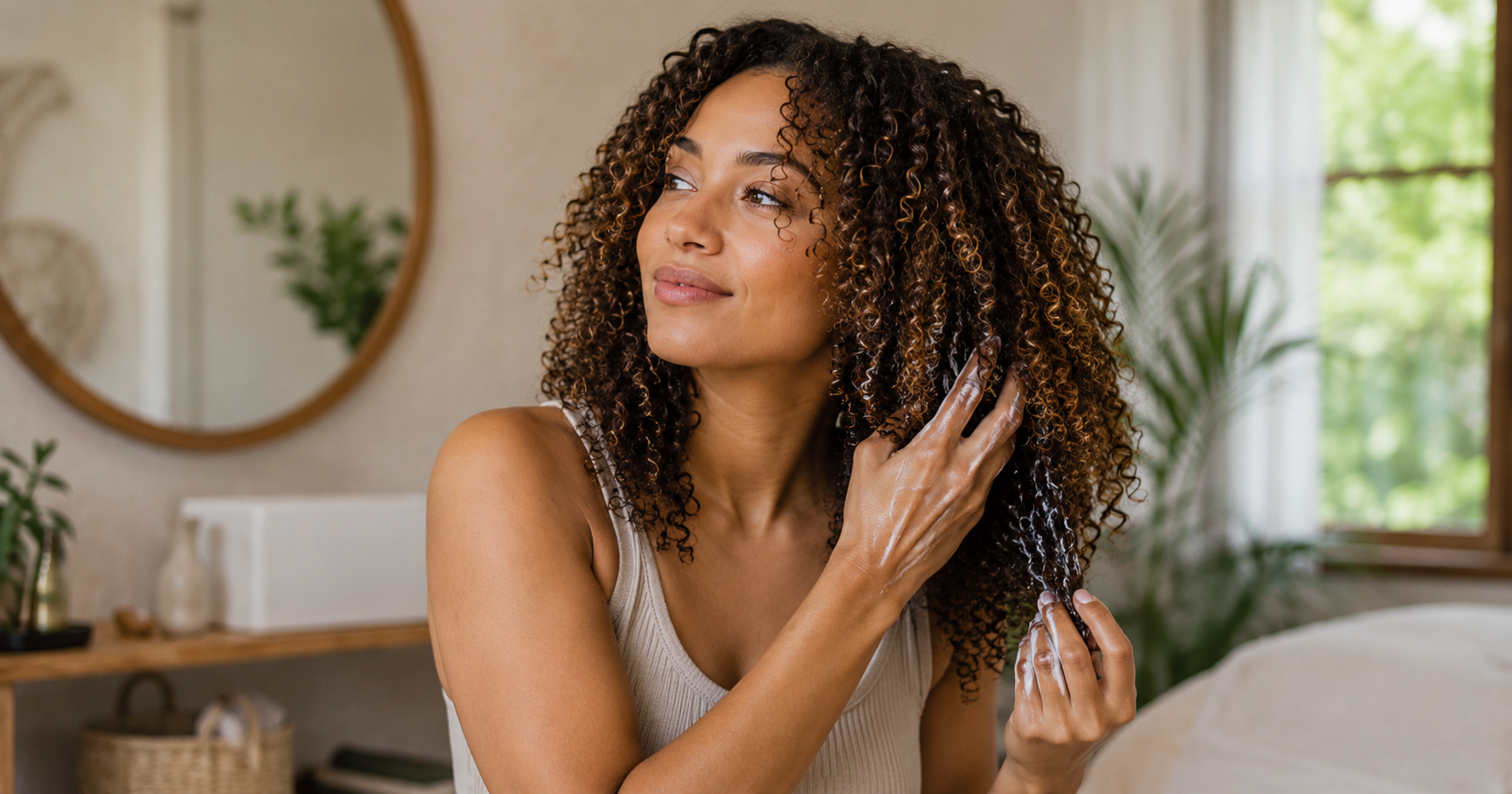
Would you like to start with a natural curly hair routine, but are you finding it hard to see what you really need for your hair, with all the shampoos, conditioners, leave-in treatments, creams, mousses and gels? A good curly-hair routine doesn’t have to involve a cupboard full of products. With a few well-chosen products and the right order of application, you can often go a long way.
Which routine works best doesn’t just depend on your curl type. The thickness and condition of your hair, the needs of your scalp and the amount of styling products you use all play a part. In this guide, Diana draws on her experience in the hair salon to explain how to get started in five simple steps.
Which routine suits you best doesn’t just depend on your curl pattern.
Your hair thickness, condition and desired result also play a part.
Find out what type of curls you have and which products are best suited to them.
Would you like to view all the relevant products straight away? If so, go to our overview of natural hair products for curls.
What products do you need for a natural curly hair routine?
For a simple basic routine, you usually don’t need more than:
- a mild shampoo;
- a conditioner or hair mask;
- a leave-in conditioner, if required;
- one styling product, such as mousse, curl cream or gel.
You don’t have to use every possible product straight away. Fine or wavy hair, for example, can quickly become weighed down by a rich leave-in conditioner, a cream and a gel. Dry, thick or very curly hair, on the other hand, sometimes needs more care.
So start simple. Only add an extra product when you notice your hair needs it. That way, you’ll be better able to work out which product makes a difference and avoid different products interfering with each other.
A natural curly hair routine starts with your hair and scalp
Curl types can help to describe the texture of your hair, but they don’t tell the whole story. Two people with roughly the same curl pattern may still need completely different hair care routines.
Before you start, be sure to pay particular attention to the following features:
- Fine or thick hair: Fine hair tends to become weighed down more quickly, whilst thick hair can often cope with more product.
- Dry or greasy quickly: Take your scalp’s needs into account when choosing your shampoo and deciding how often to use it.
- Undamaged or damaged: Coloured, porous or damaged hair may require more intensive care.
- A lot or a little hair: The amount of hair also helps determine how much product you need.
- Loose waves or tight curls: Loose waves often require less styling than dry, tight curls.
Diana’s beauty tip: When using a new product, start with less than you think you’ll need. You can always add more, but it’s much harder to remove excess product or styling from your hair.
Step 1: Gently wash your hair and scalp
The first step in a natural curly hair routine is a shampoo that suits both your scalp and the condition of your hair.
A good hair care routine starts with a clean scalp. Choose a shampoo that cleanses thoroughly, but doesn’t leave your hair feeling unnecessarily dry or stiff.
Apply the shampoo mainly to the scalp. Massage gently with your fingertips and, whilst rinsing, let the lather run down the lengths of your hair. The ends usually do not need to be washed thoroughly on their own.
How often you should wash curly hair varies from person to person. Some people wash it once a week, whilst others need to wash it more often due to sebum, exercise, scalp problems or the use of styling products. There is therefore no one-size-fits-all rule. Also, the American Academy of Dermatology recommends tailoring the frequency of washing to your hair type and the needs of your hair and scalp.
Does your hair feel heavy, sticky or dull, and are your usual products suddenly not working as well? If so, you may have a build-up of styling products. A more thorough cleanse may then be helpful. However, such a detox or deep cleanse isn’t automatically necessary with every wash or for every beginner.
Want to find out more about choosing shampoo? Then have a read of: the best natural shampoo for curly hair.
Step 2: Use conditioner or a hair mask
After washing, conditioner helps to make the lengths more supple and easier to comb through. Make sure to work the conditioner through the lengths and ends in particular. If you have fine hair or hair that gets greasy quickly, keep the product away from the scalp.
Gently detangle your hair whilst the conditioner is still in it. You can do this with your fingers or with a suitable comb or brush. Start at the bottom, near the ends, and work your way up slowly. This will prevent you from pulling unnecessarily on wet and fragile hair.
A hair mask is richer than a regular conditioner and doesn’t usually need to be used every time you wash your hair. It may be suitable if your hair feels very dry, coloured or damaged. For fine hair, however, an intensive mask may actually be too heavy. So do pay attention to the results and not just to the advice on social media.
Does your hair need a bit of extra care? Then take a look at our selection hair masks for curly hair.
Water or protein?
Many curl care products focus on hydration or protein. Hydrating and nourishing products are designed to make the hair feel softer and more supple. Products containing protein can provide support for hair that feels limp, porous or damaged.
Protein isn’t necessarily better, and you don’t have to use only protein-free products either. The right balance varies from person to person. If your hair feels hard, stiff or dry after use, use the protein product less often and alternate with a gentler, nourishing routine.
Step 3: Use a leave-in conditioner if necessary
You don’t rinse out a leave-in conditioner. It provides extra care for the lengths and can help keep your hair more manageable whilst styling.
Apply a small amount to wet hair and work it evenly through the lengths. Do not start right at the roots, unless the product is specifically designed for that purpose.
A leave-in conditioner is particularly useful for dry, thick, long or very curly hair. Do you have fine hair or loose waves that tend to go flat quickly? If so, try using just a small amount first, or skip this step altogether. A conditioner and a light styling product may be all you need.
Take a look at our selection leave-in conditioners for wavy and curly hair when you want to give your hair some extra care.
Diana’s beauty tip: Does your hair go flat, greasy or stringy straight after washing? If so, you may be using too much product or a combination that’s too heavy. Try using less first, before changing your entire routine.
Step 4: choose one suitable styling product
After the treatment comes the styling. Which product you choose depends on the result you want.
Curling mousse for lightness and volume
Mousse is usually a good choice for fine hair, loose waves or curls that tend to go limp. It provides hold without the same heavy feel as some creams. Work the mousse through wet hair and scrunch the curls into shape, working from the bottom up.
Curling cream for conditioning and defining curls
A curl cream is often ideal for drier, thicker or frizzy curls. The cream helps to keep the hair together and provides extra nourishment. If you have fine hair, use only a small amount to prevent it from going limp.
Take a look at our selection curling cream for wavy and curly hair if you’re looking for more softness, nourishment and definition.
Gel for definition and longer-lasting hold
As it dries, gel forms a thin layer around the curl, giving it greater hold and definition. The hair may feel temporarily stiff after drying. This is also known as a ‘gel cast’.
Once your hair is completely dry, you can gently squeeze the hard cast off. The curls will then feel softer, whilst retaining some of their definition and hold.
Take a look at our selection gel for wavy and curly hair if you’re looking for more definition and firmness.
Can you combine cream, mousse and gel?
That’s possible, but it isn’t always necessary for beginners. It’s best to start with just one styling product. That way, you’ll be able to see more clearly what effect it has on your hair.
If you need extra care and hold later on, you could, for example, combine a small amount of leave-in conditioner or cream with gel. For volume, you could combine mousse with a light gel. Use less of each product when applying several products on top of one another.
Step 5: Dry your curls without constantly touching them
Once you’ve applied the styling product, you can let your curls air-dry or use a diffuser. A diffuser disperses the air and helps prevent the curls from being blown in all directions.
It is best to use a gentle air setting and avoid unnecessarily high temperatures. Move the hair as little as possible whilst drying. Touching your hair too much whilst it is still wet can break up the curls and cause more frizz. Gloucestershire Hospitals in the UK also advises letting your hair dry naturally where possible, or using a hairdryer on the lowest heat and power settings.
Please also read the external advice on Dry gently and handle with care when using heat.
Gently pat or squeeze excess water out of your hair using a soft hair towel or cotton cloth. Rubbing vigorously with a bath towel will cause the sections you’ve formed to come undone more quickly.
Wait until your hair is completely dry before squeezing out any gel cast. If it’s still damp on the inside, the curl may lose its shape more quickly.
Three simple variations on a natural curly hair routine
Use the examples below as a starting point for your natural curl routine and adjust the amount and richness of the products to suit your own hair.
Routine for fine or wavy hair
- Gentle shampoo
- Light conditioner
- Mousse or light gel
- Air-drying or diffusing
Skip using a rich leave-in conditioner or cream at first. Only add it if your hair still feels dry.
Routine for dry or thicker curls
- Gentle shampoo
- A nourishing conditioner or an occasional hair mask
- A small amount of leave-in conditioner
- Curling cream or gel
- Leave to dry gently and gently squeeze the plaster cast
Routine for damaged or limp curls
- Gentle shampoo
- Alternating between a moisturising treatment and a product containing protein
- Light leave-in conditioner, if required
- Mousse or gel for support
- As little heat and pulling on the hair as possible
Don’t change everything at once. Introduce one new product and assess the results after several washes.
Common mistakes in a natural curly hair routine
Using too many products at once
Using more products doesn’t automatically result in better curls. Layering conditioner, leave-in conditioner, cream, mousse, gel and oil can actually make your hair feel heavy or sticky.
Just look at the curl type
The curl pattern tells you very little about the thickness, condition and needs of your scalp. You should therefore always look at the overall appearance of your hair.
Applying too much product to the roots
Applying too much product to the roots can reduce volume and make the scalp look greasy more quickly. Make sure to apply conditioner, leave-in treatment and cream mainly to the lengths of your hair.
Keeping on buying new products without adjusting the quantity
A product may be suitable in itself, but you may simply be using too much of it. Try a smaller amount or a simpler combination first.
Touching your hair before it’s dry
Curls take their shape as they dry. Constantly touching them or pulling them apart often causes them to frizz more quickly.
Start straight away with a combined routine
Don’t want to sort through all the products one by one? The Curls Basic Care Package has been put together to provide a straightforward routine for cleansing, conditioning and styling.
Are you looking for a more comprehensive routine with several skincare and styling steps? Then take a look at the Complete Curl Routine Package.
You can also compare products yourself in our comprehensive overview of natural care and styling for curls. There you’ll find, amongst other things, shampoo, conditioner, hair masks, leave-in products, creams, mousse and gel.
Personalised advice from the hair salon
No two heads of curly hair are the same. What gives someone else’s hair beautiful definition might actually weigh your hair down or leave it feeling dry. That’s why we select and test our products based on our experience in our own hair salon.
Can’t work it out? Then take a look at the options for personalised hair care advice. Please tell us how your hair feels, which products you’re currently using and what problems you’re having. That way, we can offer you much more tailored advice.
Frequently asked questions about your natural curls routine
As a beginner, which products do I really need?
Start with a gentle shampoo, conditioner and one styling product. Only add a leave-in conditioner or hair mask when your hair needs extra care.
Do I have to follow the Curly Girl Method to the letter?
No. A method can provide guidance, but ultimately it’s your scalp and hair that determine what works. A product that fits within a particular method isn’t automatically suitable for everyone with curly hair.
Do I always have to do a detox before I start?
No. A deeper cleanse can be helpful if styling products have built up, but it isn’t automatically necessary for every beginner. Check how your hair and scalp feel.
Should I use leave-in conditioner, cream or gel first?
The usual order is leave-in, followed by a cream or mousse if desired, and finally gel. However, you don’t have to use all the steps. Start with the simplest combination that gives you the results you want.
How often should I wash my curls?
It varies from person to person. Let your scalp be your guide. Wash your hair when your scalp feels greasy, uncomfortable or dirty, or when styling products have clearly built up.
Why do my curls go flat after washing?
This may be due, amongst other things, to over-conditioning, using too much product, a lack of firmness, or touching your hair too much whilst it’s drying. Try using less product and a lighter routine to start with.
Ready to put together your routine?
Start your natural curly hair routine It’s simple: don’t use more than your hair needs, and give yourself time to find out which combination works best for you. See all natural hair products for curls or opt for a ready-made package.

About Diana - The Natural Hairdresser
Diana is a hairdresser through and through: hands in hair, feet in clay. She tests every product herself in her salon. Only products that really work and contribute to natural, healthy hair end up in our webshop. That way, you can be sure you are choosing pure, professional quality.